Broadcast workflow ecosystem

One broadcast ecosystem. From newsroom to air.

ILURO connects newsroom, media, ingest, graphics, prompting, playout, Mosaic, Conductor and transfer workflows into one operational broadcast system.

Newsroom

Conductor

MAM

Ingest

Transfer

Playout

CG

Script

Mosaic

Rundown / MOS

ILURO

Shared context.

Ecosystem map

A connected operational graph, not a loose product list.

Newsroom planning, media readiness, ingest, transfer, Conductor and live outputs share one operational context, keeping rundown, MOS, assets and execution state aligned.

Editorial source

Rundown structure, MOS state and execution planning are authored here.

Newsroom

Editorial planning, rundown orchestration, MOS-aware execution plans and AI-assisted story preparation for downstream broadcast systems.

Media operations

Material is captured, searched, inspected and moved with context.

MAM

S3-backed asset lifecycle with proxy playback, transcript and translation review, People Discovery, AI-assisted enrichment and backend edit/render workflows.

Ingest

Live SDI/NDI capture, scheduled recording and MAM-aware session state for safe preview and downstream media readiness.

Media Transfer

Controlled media movement between locations, relay storage and production storage with visible transfer state and verified delivery.

Conductor layer

Timing, triggers and device-aware execution coordinate the stack.

Conductor

Turns published rundown plans into operator-paced execution sessions with timeline control, device state and execution evidence.

On-air execution

Output, graphics, prompting and wall execution stay tied to the show.

Playout

Executes Newsroom/MOS-driven A/B playout with shared playlist control, live channel status, audio metering, MAM media browsing and SDI/NDI/SRT output.

CG

Executes Newsroom/MOS-driven CG with template fields, cue/TAKE control, live engine state and NDI-backed operator preview.

Script

Runs Newsroom/MOS-driven prompting with script delivery, operator speed/navigation control, live runtime snapshots and agent-rendered output.

Mosaic

Executes Newsroom/MOS-driven wall output with target bindings, armed/program state, TAKE/Fade control and per-target confidence preview.

Planning, media, graphics, prompting and playout are framed as connected operations. The map stays readable without depending on animation.

Interface proof

Operational surfaces where the ecosystem becomes visible.

Large interface proof blocks show how editorial planning, media authority and live execution carry the same rundown, asset and device context across the stack.

Proof 01Editorial command surface

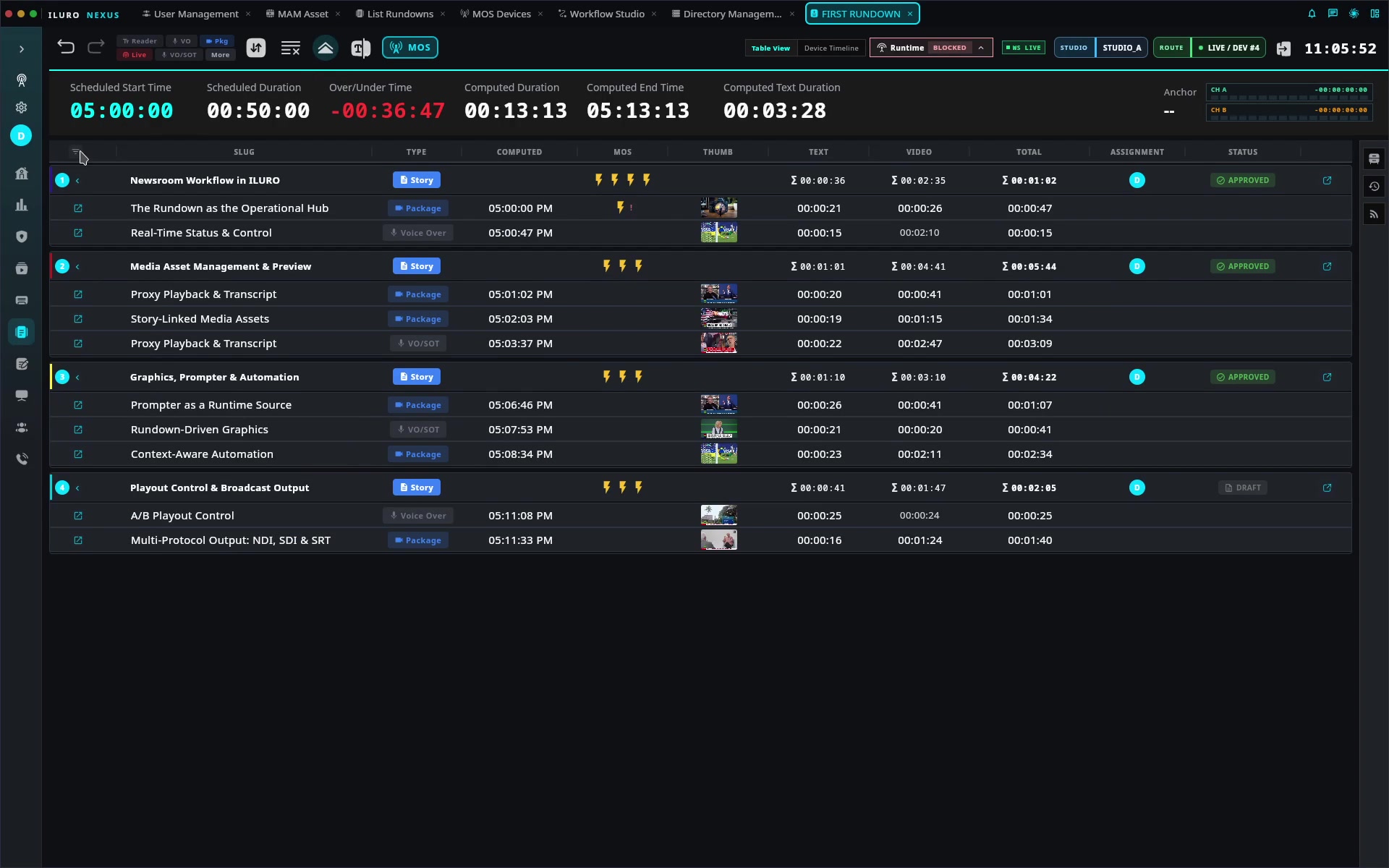
Newsroom command view

Rundown planning becomes execution-ready broadcast context.

Newsroom keeps story order, item timing, media references, CG cues, prompting text and MOS handoff visible while compile readiness checks prepare the rundown for downstream systems.

RundownMOSCompile readinessMAM contextExecution plan

Rundown structure

Stories, items, timing and source lineage stay ordered for editorial teams before they become operational output.

Compile readiness

Blockers, warnings, MAM asset checks and device bindings can be reviewed before a rundown is used live.

Downstream handoff

CG, playout, prompting, Mosaic and Conductor receive prepared context instead of isolated operator notes.

ILURO Newsroom · ILURO NEXUS
Proof 02Media authority surface

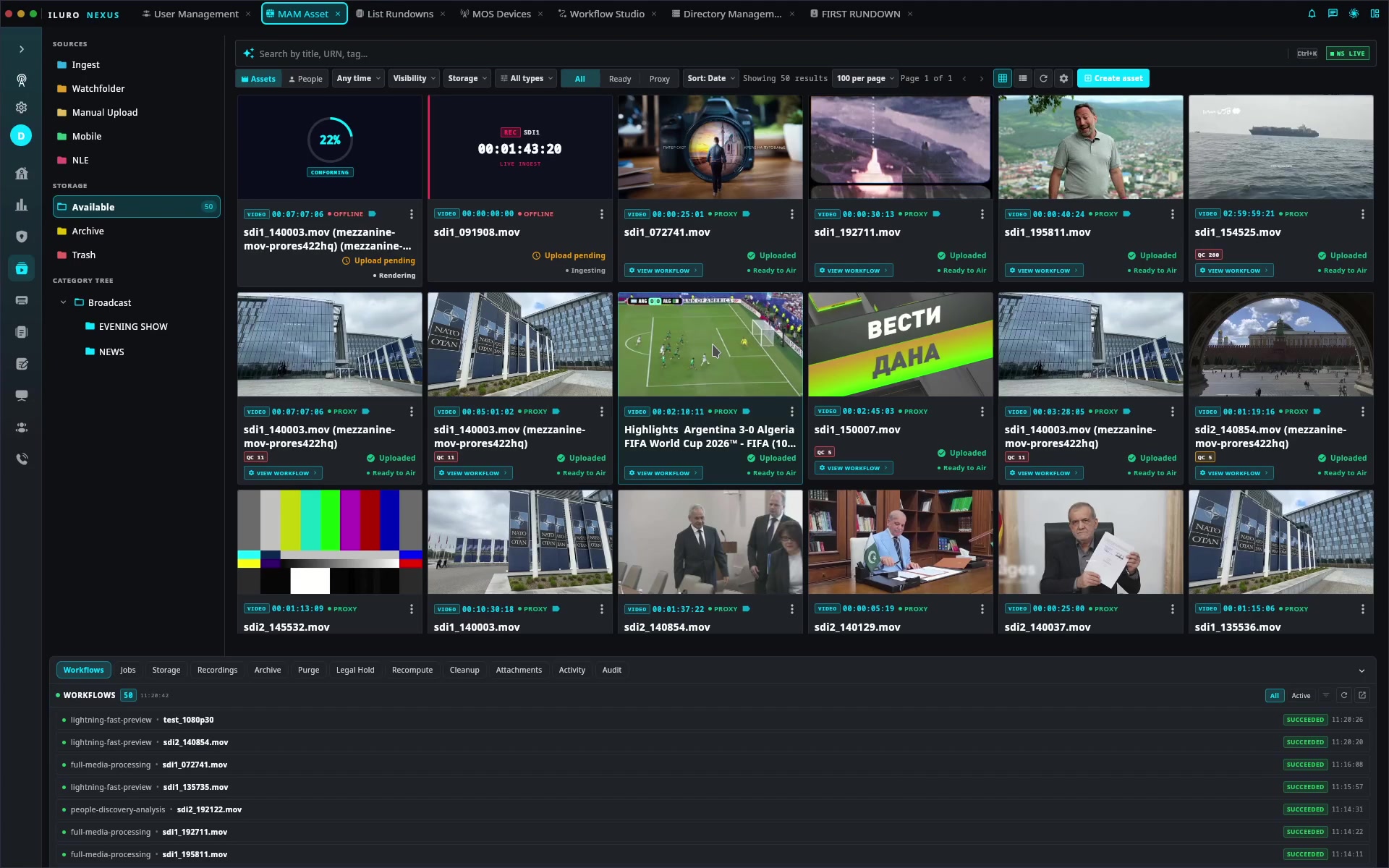
MAM asset authority

MAM keeps media truth ready for editorial and downstream use.

MAM owns the S3-compatible asset lifecycle, proxy and thumbnail readiness, transcript and translation review, People Discovery and edit/render outputs before media becomes a newsroom or playout dependency.

Asset authorityS3 lifecycleProxyTranscript/translationEdit/render

Asset lifecycle

Media can move through ingest, review, approval and ready-to-air state with metadata and readiness attached.

Review context

Proxy playback, thumbnails, transcript, translation and People Discovery make long-form media searchable and usable.

Downstream readiness

Newsroom and playout-facing workflows can consume current MAM state instead of stale file references.

ILURO MAM · ILURO NEXUS
Proof 03Media intake surface

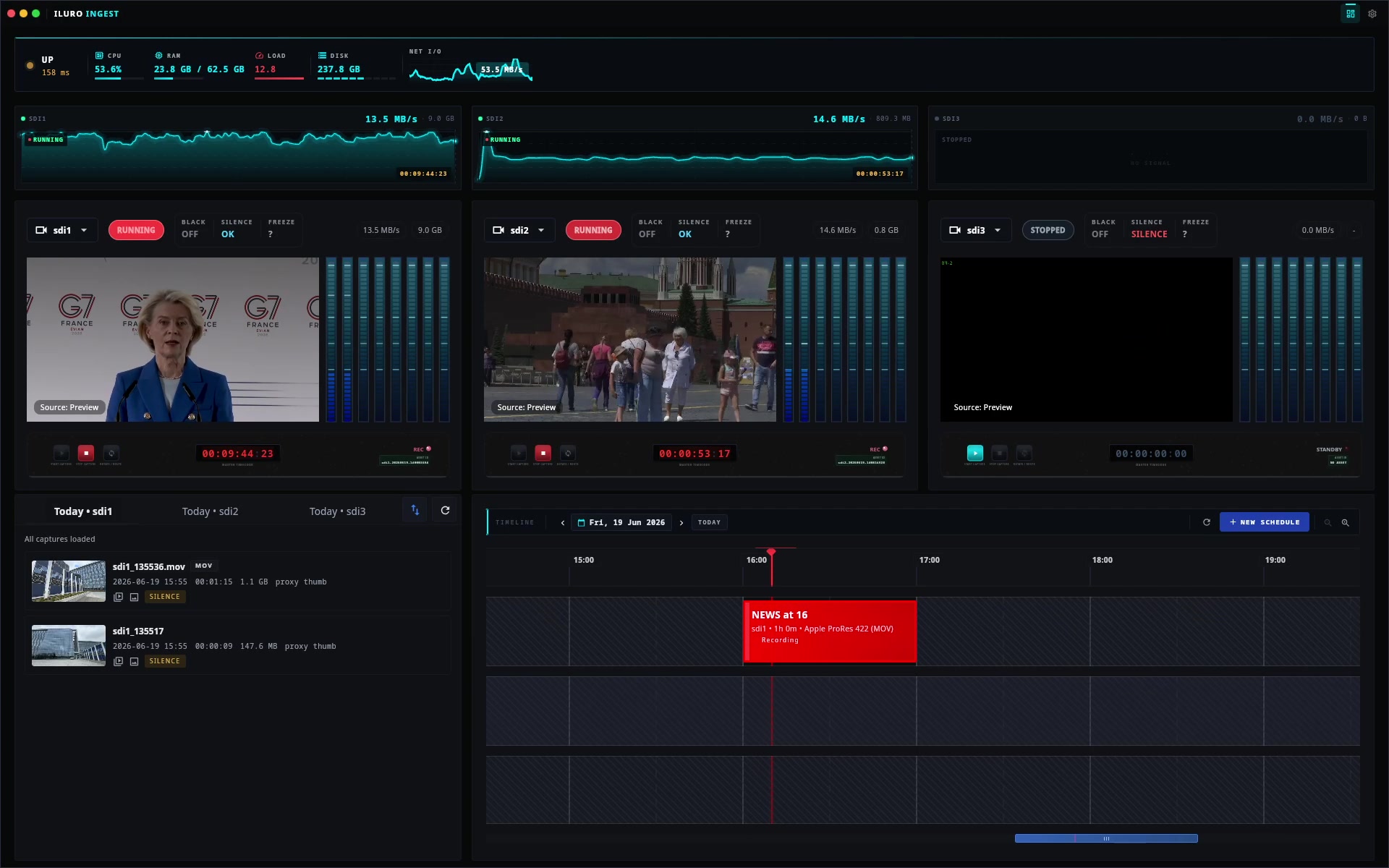
Ingest capture control

Ingest turns live signals into MAM-ready media with confidence.

Ingest coordinates SDI/NDI capture, scheduled recording, signal assurance and MAM recording sessions so operators can monitor active capture, preview stabilized media and hand off metadata before MAM owns the canonical asset.

SDI/NDI captureScheduled recordingSignal assuranceGrowing mediaMAM handoff

Capture control

Operators can start, stop, monitor and recover live capture sessions while schedule and source state stay visible.

Signal assurance

Signal lock, audio, black-frame, freeze, preview and monitoring confidence stay visible while recording is active.

MAM-ready handoff

Recording sessions can expose stabilized preview state and metadata before proxy, thumbnail, QC and origin workflows continue in MAM.

ILURO Ingest
Proof 04Live playout surface

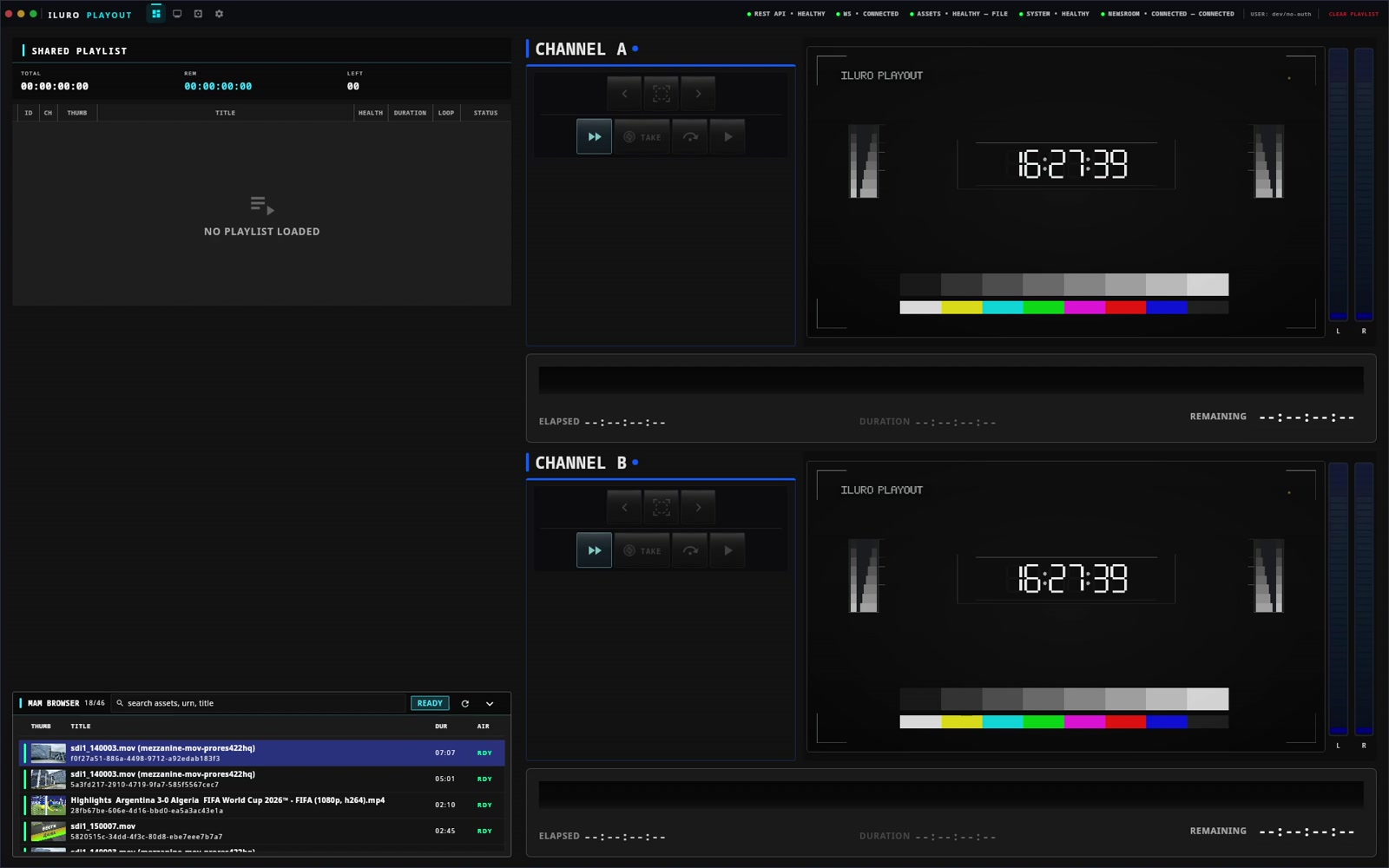
Playout A/B execution

Playout executes prepared rundowns with A/B channel confidence.

Playout turns Newsroom/MOS rundown intent and MAM-resolved media readiness into controlled A/B execution, with shared playlist state, cue/take visibility, audio metering and SDI/NDI/SRT output confidence.

A/B playoutShared playlistCue/takeMAM readinessSDI/NDI/SRT

Shared playlist execution

One authoritative playlist drives Channel A and Channel B, keeping selected, cued, live and next state visible to operators.

Media readiness

MAM-derived metadata, resolver state and staging confidence are checked before media becomes channel output.

Output confidence

SDI, NDI and SRT-oriented output status, preview monitoring and audio meters keep live execution observable.

ILURO Playout
Proof 05Graphics runtime surface

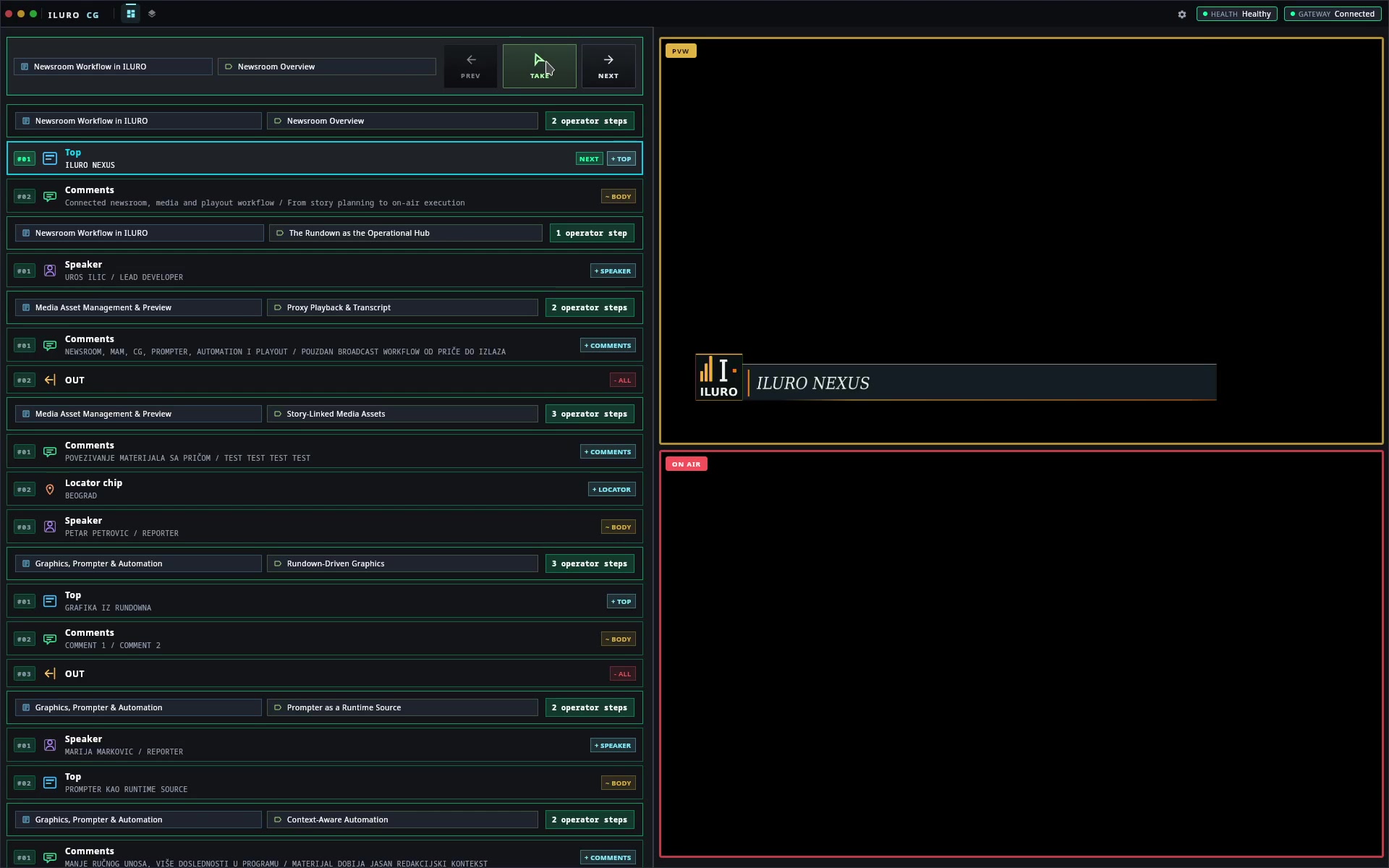
CG cue control

CG combines graphics editing with newsroom-driven live execution.

CG connects a dedicated template editor with newsroom/MOS-driven graphics execution, so template fields, cue icons, preview, TAKE control and live engine feedback stay tied to the same broadcast graphics workflow.

CG EditorTemplate fieldsMOS graphicsCue/TAKEPGM/PVW

CG Editor

Templates can be prepared with structured fields, properties, timing, validation and publish readiness before they reach the operator view.

Operator execution

Rundown graphics, cue icons, PREV/TAKE/NEXT controls and readiness feedback keep live operation tied to newsroom context.

Program and preview

PGM and PVW monitoring separate on-air output from look-ahead verification, with engine feedback visible to operators.

ILURO CG
Proof 06Operator prompting surface

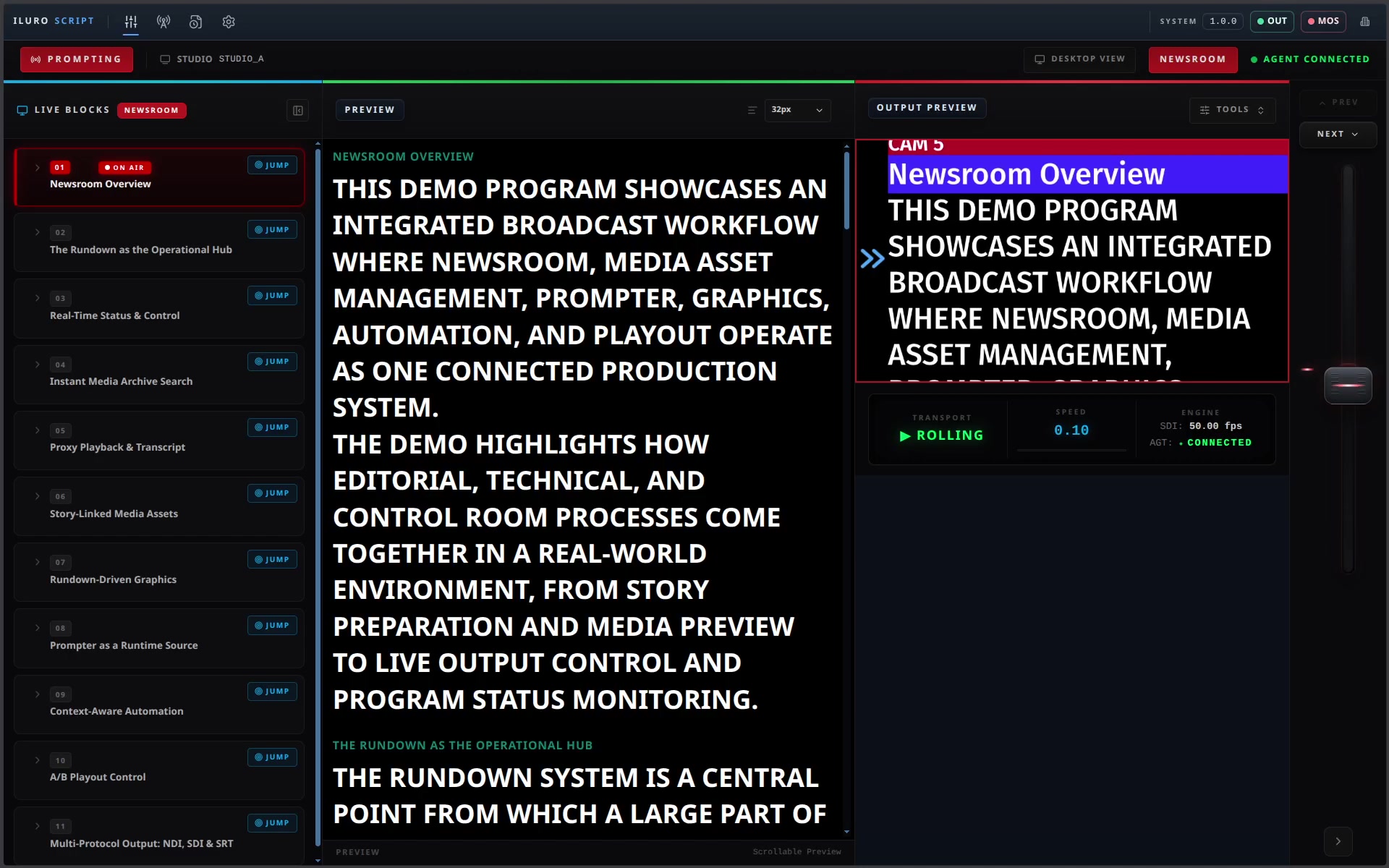
ILURO Script operator

Prompting runs from newsroom text to native output confidence.

ILURO Script turns Newsroom/MOS rundown text into controlled prompting runtime, giving operators speed, navigation, source mode, program output and live agent preview without treating prompting as a detached text scroller.

Newsroom/MOSVelocity controlNative agentProgram outputConfidence preview

Newsroom-driven script

Rundown text, blocks and cue identity can move from editorial changes into the prompting runtime with clear story context.

Operator control

Source mode, velocity, block jumps, play/pause and program output controls keep live prompting under operator control.

Agent confidence

Live preview, FPS, scroll state and output feedback come from the native output agent, not from a local UI-only preview.

ILURO Script
Proof 07Mosaic output surface

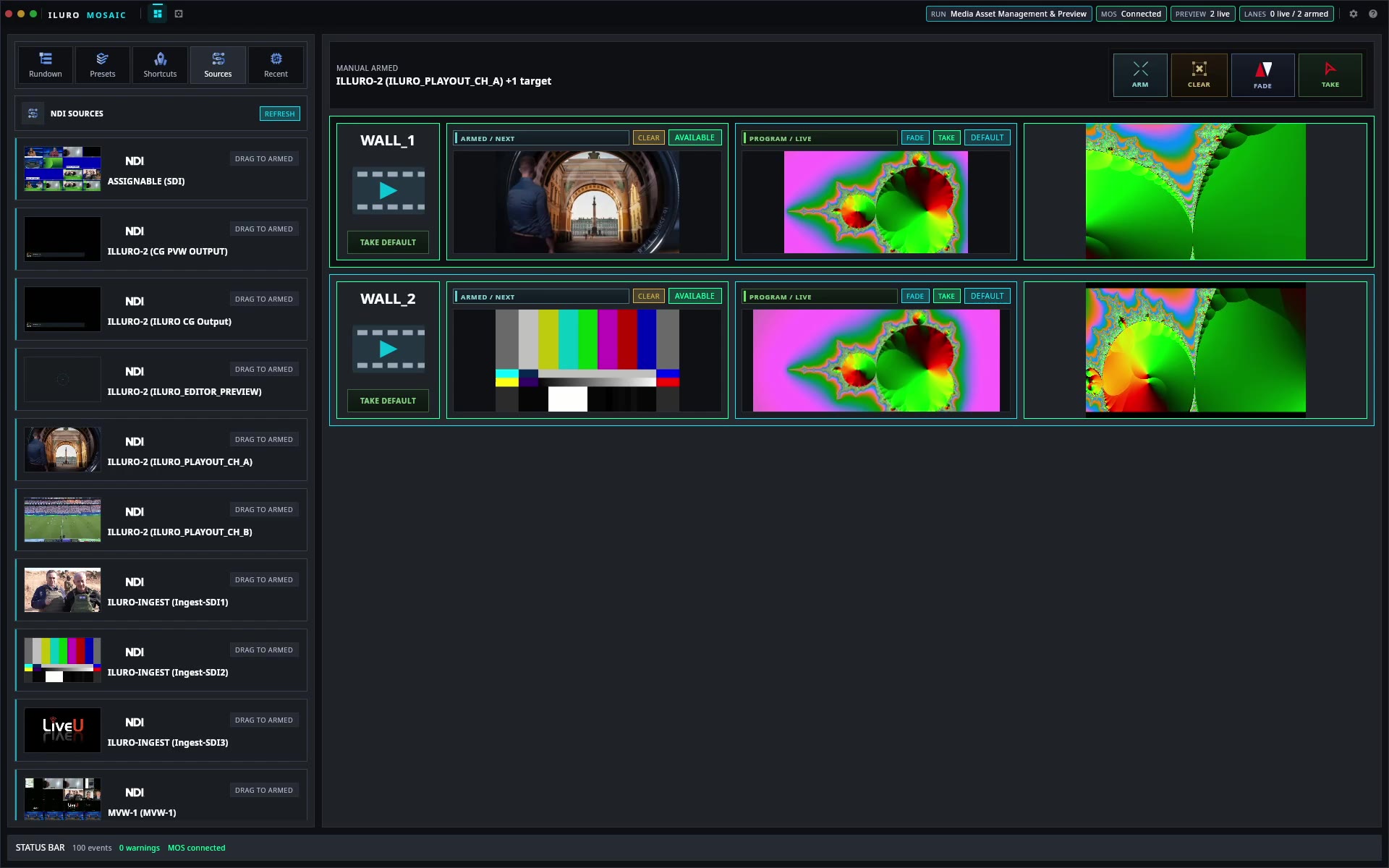
Mosaic operator surface

Mosaic turns newsroom wall cues into controlled live output.

ILURO Mosaic executes Newsroom/MOS-driven video wall output with target bindings, armed/program state, TAKE/Fade control, manual NDI routing, per-target confidence preview and Studio topology awareness.

Newsroom/MOSTarget bindingsArmed/programTAKE/FadeStudio topology

Target bindings

Newsroom wall cues resolve into target codes, zones and outputs so operators can see where each assignment will land before it goes live.

Armed to program

Armed/Next and Program/Live state make TAKE/Fade operation explicit across whole-wall and per-target execution.

Manual and studio control

Operators can route manual NDI sources while Studio views keep wall outputs, geometry, active area and assignment state visible.

ILURO Mosaic
Proof 08Conductor execution surface

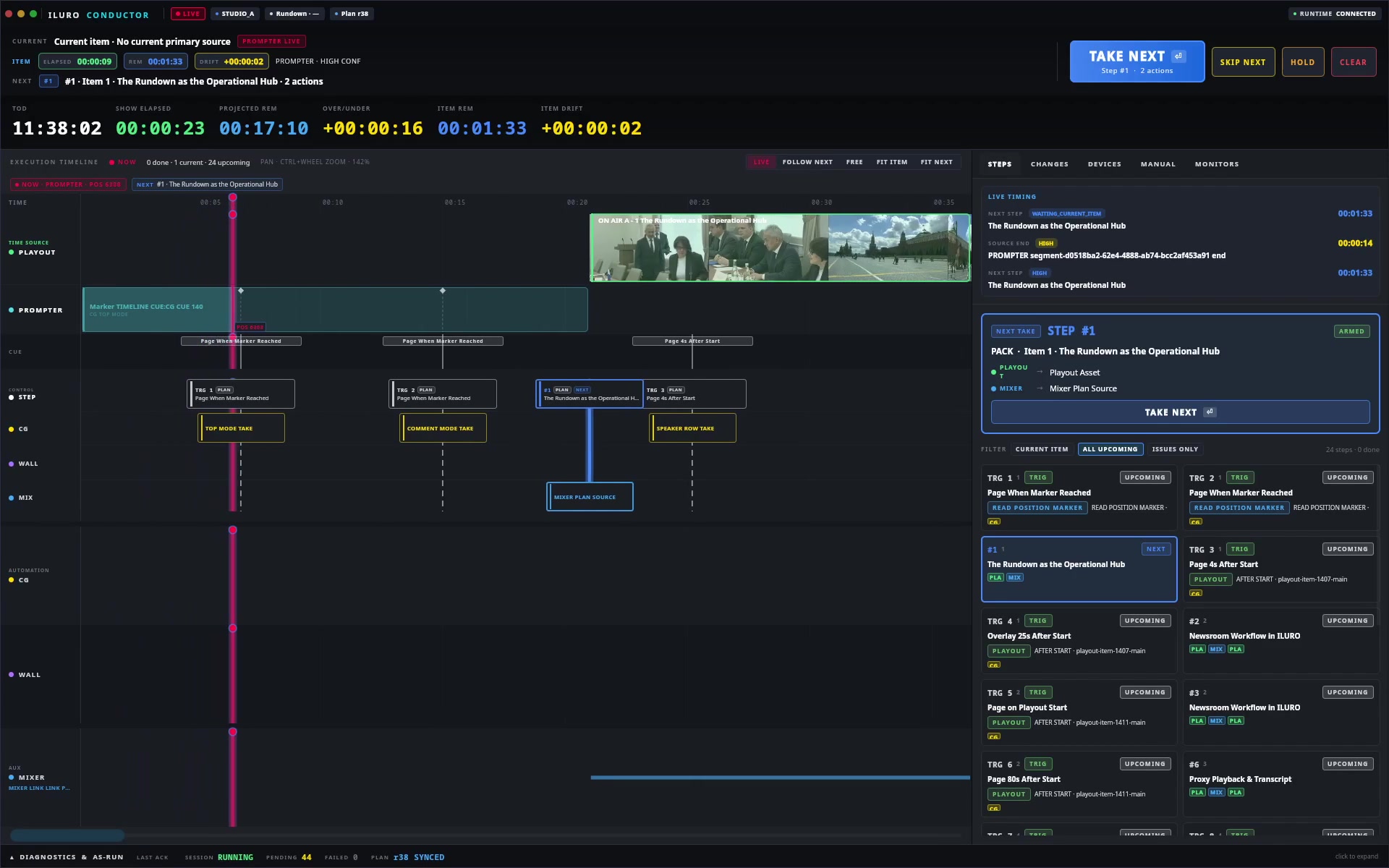
Conductor live execution

Conductor turns published rundown plans into operator-paced execution.

ILURO Conductor synchronizes Newsroom-published execution plans into live sessions where TAKE NEXT, HOLD/SKIP, plan changes, device state, timing and execution evidence stay visible before and after each action.

Published plansTAKE NEXTHold/SkipDevice stateExecution evidence

Published plan sync

Newsroom remains the authoring source while Conductor keeps the live execution session aligned with the latest approved plan.

Operator-paced control

TAKE NEXT, HOLD/SKIP and SET NEXT controls make the next committed action explicit before it reaches downstream systems.

Runtime evidence

Current/next state, timing, device feedback, failures and plan-change conflicts stay visible during live operation.

ILURO Conductor

Operational workflow

From newsroom intent to live output, the state stays connected.

ILURO is strongest where editorial intent, media readiness, device context and live runtime state move through one broadcast ecosystem without becoming detached operator notes.

State handoff

Authoring, media and runtime truth stay aligned.

Aligned
Source truthNewsroom authors rundown, MOS context and published execution plans
Media truthIngest, MAM and Transfer keep assets ready, reviewed and resolvable
Runtime truthPlayout, CG, ILURO Script, Mosaic and Conductor expose live execution state

01 / workflow path

Rundown state becomes a publishable execution plan.

Newsroom / MOSCompile readiness

Newsroom keeps story order, item timing, MAM references, CG cues, ILURO Script blocks, wall targets and MOS context together through compile readiness before downstream systems receive the same prepared broadcast context.

01

Author

02

Validate

03

Publish

04

Handoff

One prepared rundown context feeds every downstream surface.

02 / workflow path

Media truth moves from capture to downstream readiness.

Ingest / MAM / TransferAsset readiness

Ingest registers and assures capture sessions, MAM owns asset lifecycle, proxy, transcript, review and readiness, while Transfer moves verified media between sites before editorial, playout or wall output depends on it.

01

Capture

02

Register

03

Review

04

Resolve

Operators work from current media truth, not stale file paths.

03 / workflow path

Dedicated runtimes keep outputs connected to the rundown.

CG / ILURO Script / Mosaic / PlayoutRuntime boundary

CG, ILURO Script, Mosaic and Playout consume Newsroom/MOS intent while preserving their own operator controls, preview surfaces and engine feedback for graphics, prompting, wall output and channel output.

01

Project

02

Bind

03

Preview

04

Operate

Specialized outputs stay connected without becoming detached tools.

04 / workflow path

Published plans become operator-paced live execution.

Conductor runtimeTAKE NEXT

Conductor synchronizes approved execution plans into live sessions where TAKE NEXT, HOLD/SKIP, plan changes, timing, device state and execution evidence stay visible across rehearsal and live operation.

01

Sync

02

Hold

03

Take

04

Verify

Live execution stays controlled, explainable and recoverable.

Module boundaries

Each product owns a clear part of the broadcast state.

ILURO modules are not duplicate screens around the same data. Each product owns one operational boundary, reads upstream truth and hands off verified state to the next live surface.

Source truth

Newsroom authors rundown, MOS and execution plans

Media truth

Ingest, MAM and Transfer keep assets ready and movable

Runtime truth

Live products expose output, timing and device state

01 / Editorial control

ILURO Newsroom

Owns

Rundown structureMOS contextCompile readinessPublished execution plans

Reads

MAM asset readinessStory and media metadata

Hands off

CG cuesILURO Script blocksPlayout intentMosaic targetsConductor plan

Proof signal

Compile blockers, warnings and downstream readiness

02 / Media operations

ILURO MAM

Owns

Asset lifecycleProxy and thumbnailsTranscript reviewMedia readiness

Reads

Ingest sessionsTransfer deliveriesEditorial usage context

Hands off

Current media truthResolved media stateReview context

Proof signal

Asset readiness that can be re-resolved before use

03 / Media intake

ILURO Ingest

Owns

Capture sessionsScheduled recordingSignal assuranceEarly MAM registration

Reads

SDI/NDI sourcesRecording schedulesCapture profiles

Hands off

MAM-ready growing mediaCapture metadataAssurance events

Proof signal

Safe preview, session heartbeat and proxy/QC handoff

04 / Live execution

ILURO Playout

Owns

A/B channel executionShared playlist stateOutput confidence

Reads

Newsroom/MOS intentMAM-resolved mediaConductor cues

Hands off

Live channel statusAudio and timing feedbackExecution history

Proof signal

Cue/TAKE state, audio meters and SDI/NDI/SRT status

05 / Graphics execution

ILURO CG

Owns

Template/runtime graphicsCue/TAKE statePGM/PVW confidence

Reads

Newsroom/MOS graphics cuesTemplate fieldsConductor actions

Hands off

Graphics output stateEngine feedbackReadiness results

Proof signal

CG Editor, cue/TAKE controls and PGM/PVW monitoring

06 / Prompting

ILURO Script

Owns

Prompting runtimeSpeed/navigation controlAgent-rendered output

Reads

Newsroom/MOS textRundown orderOperator source mode

Hands off

Program outputRuntime snapshotsScroll/FPS feedback

Proof signal

Velocity control, agent preview and scroll state

07 / Live execution

ILURO Mosaic

Owns

Wall output executionTarget bindingsArmed/program state

Reads

Newsroom/MOS wall cuesMAM/NDI sourcesStudio topology

Hands off

Live wall statePer-target confidenceAssignment feedback

Proof signal

TAKE/Fade, target readiness and Studio assignment

08 / Conductor layer

ILURO Conductor

Owns

Runtime execution sessionPlan syncTAKE NEXTHOLD/SKIP

Reads

Newsroom-published planDevice statePlan changes

Hands off

Operator-paced executionTiming feedbackExecution evidence

Proof signal

Current/next state, plan conflicts and device feedback

09 / Service layer

ILURO Media Transfer

Owns

Site-to-site movementRoute policyTransfer lifecycleVerified delivery

Reads

Local storageTransfer requestsDestination policy

Hands off

Delivered mediaReceipt stateMAM/storage intake

Proof signal

Transfer lifecycle, delivery receipt and agent telemetry

Engineering foundation

A broadcast stack built across native engines, services and edge runtimes.

ILURO separates the stack by broadcast responsibility: C++ engines protect timing, rendering and signal output; Spring services hold editorial, media and execution truth; Rust agents move media at the site edge; and operator clients surface live state without hiding the systems underneath.

01 / stack layer

C++ media runtimes

C++ / FFmpeg / DeckLink / NDI

Playout, CG, Mosaic and ILURO Script output use native runtimes around FFmpeg, Blackmagic DeckLink, NDI, OpenGL, DRM/KMS and gRPC where timing and confidence matter.

02 / stack layer

Spring service layer

Spring / APIs / durable state

Newsroom, MAM, Ingest, Conductor and Transfer control-plane services coordinate rundown state, asset readiness, capture sessions, plan sync and workflow APIs.

03 / stack layer

Rust edge agents

Rust / SQLite / relay

Watchfolder and Transfer agents run close to the site with local spool, job persistence, relay handoff, runtime progress and evidence that survives outside the central service path.

04 / stack layer

Operator clients

Desktop / realtime / operator UI

Operator-facing clients expose live state from Newsroom, MAM, Playout, CG, Mosaic, Transfer, Conductor and prompting workflows without pretending the UI owns the runtime.

Broadcast integration layer

Integration points stay visible across the broadcast chain.

ILURO keeps the important handoffs readable: MOS and rundown identity, current media readiness, live runtime feedback, output confidence and site-to-site delivery state remain visible as work moves between products.

Integration trace surface
Inspectable
Handoff typeEditorial, media, runtime and delivery
Trace pointIdentity, readiness, feedback and delivery state
Operator valueThe integration remains inspectable when systems diverge

01 / Editorial identity

MOS and rundown identity

Newsroom carries story order, MOS objects, cue references and published execution intent into CG, ILURO Script, Mosaic, Playout and Conductor without making downstream systems own editorial order.

MOS objects
Story identity
Cue references
Published plan

02 / Media readiness

Media readiness and resolution

Ingest, MAM and Transfer keep asset identity, lifecycle state, proxy and thumbnail readiness, transcript context and current resolver state traceable before downstream systems depend on media.

Asset identity
Lifecycle state
Proxy readiness
Resolver refresh

03 / Runtime feedback

Runtime feedback and output confidence

Playout, CG, ILURO Script and Mosaic return live state from the systems that actually execute output: channel timing, ACK/NACK, PGM/PVW, snapshots, wall state and audio confidence.

ACK/NACK
Timecode/VU
PGM/PVW
Snapshots

04 / Delivery state

Transfer and storage handoff

Media Transfer keeps coordination separate from payload movement: control-plane state, route policy, S3-compatible relay storage, local job evidence and verified delivery stay inspectable.

Route policy
S3-compatible relay
Local job state
Verified delivery

Request a technical walkthrough.

Send the workflow, device path or integration question you want to review.

Contact route
Contact typeDirect technical walkthrough
Best forWorkflow review, integration fit and demo planning
Send touros.dev.engineer@outlook.com

The conversation stays focused on real workflow context, interface proof and integration fit.

© 2026 ILURO Broadcast Systems. All rights reserved.